

RINGO is intentionally cross-sectoral, and our Social Lab includes people who are working in humanitarian and development, environment, human rights, and peacebuilding organizations. That’s because RINGO seeks to address multiple systemic issues that impact all sectors of INGOs.
Internally, abuses related to gender, structural racism, and power within INGOs impact all organizations. Shrinking civic space is a key challenge, as INGOs and activists are increasingly facing attack and scrutiny from government, rendering their work ever more complex and difficult. COVID-19 has also accelerated calls for increased localization and more bottom-up power amongst many CSOs working at the national or sub-national level. The Black Lives Matter movement has also provided a direct impetus to finally address race and diversity.
Whilst INGOs are increasingly recognizing the need to build grassroots power, to enable stronger national and subnational civil societies, there will also continue to be a need to have a multilateral approach across civil society too, bridging organizations, issues and geographies. Yet it is clear that in some respects, INGOs are inhibiting progress and replicating unequal power structures, taking a larger share of resources, and potentially impeding progressive change. How civil society functions at the global level, and how it connects with the local, are critical questions for the RINGO project.
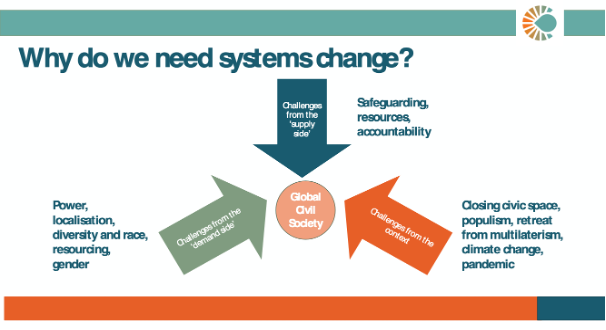
Additionally, through focused Action Pods and our Social Lab convenings, the RINGO project is exploring issues that have direct impacts and relevance in individual sectors. These include:
RINGO and Environmental Organizations – what else is relevant?
- Conflicts between conservation approaches and indigenous groups (decolonization)
- Decolonization: White Savior complex, northern narratives
- Accusations of colluding with powerful forces, for example corporates or paramilitaries
- Out of date fundraising models that reward unsustainable behaviors (e.g. consumption, corporate partnerships with polluting industries)
- Closing civic space – Growing attacks on environmental defenders
- Failure to address root causes of biodiversity loss or climate change, instead supporting contested solutions and short-term ‘fixes’ such as sustainable palm oil
RINGO and Development and Humanitarian organizations – what else is relevant?
- Safeguarding scandals: some of the responses have led to more accountability systems and pressures on local organizations, engendering less trust
- Resources: The Grand Bargain target of 25% of humanitarian funding going to local response has not yet been met.
- Closing civic space: Growing attacks on humanitarian actors, including criminalizing humanitarianism
- Political questions: a direct assault on the principles of the humanitarian neutrality, with some starting to question their efficacy
- Relationship with host governments and CSOs
- Difficulty in navigating the space between ‘service delivery’ vs. ‘advocacy’
- Sources of funding are shrinking and competition with the private sector is growing
RINGO and the Human Rights community – what else is relevant?
- Localization efforts have faced conflicts and challenges internally in organizations
- Setting up national offices have led to accusations of squeezing the fundraising of domestic human rights organizations
- Closing Civic space has impeded the ability of international actors to localize
- Accusations of bullying within the sector
- Domination of white northern voices with challenges in navigating human rights work in a way that won’t threaten local actors
- Growing challenges to human rights law internationally and a lack of clarity on how the International movement should coordinate
RINGO and the Peacebuilding Sector – what else is relevant?
- Assumptions about neutrality of northern voices are false – instead, they’re deeply rooted in colonialism and power dynamics implicated in conflict itself
- Growing polarization between local actors and multilateral spaces where peace is often negotiated, including at UN
- International engagement towards peacebuilding increasingly seen to be ineffective
- Demand for more ‘locally-led’ peacebuilding growing
Questions that RINGO is exploring that will be important for all organizations:
- Power and trust. How do we genuinely address concerns about power and dominance in civil society, by INGOs? Can INGOs see their role in #ShiftthePower and act on it? Can we support southern civil society to strengthen their own power?
- Diversity and genuine inclusion. How can INGOs address racial inequities within their own structures? How can we facilitate racial diversity in senior leadership and decision-making processes, and foster genuine inclusion at all organizational levels?
- Governance and accountability. How should INGOs be governed? Who are they accountable to now? Who should they be accountable to in future? What form of governance would create ‘effective’ accountability? How can this shift away from northern dominance? Are legal changes required?
- Funding/resources/ownership. How should INGOs be funded in order to ensure their legitimacy? For many the majority of funds come from western governments or corporates. Does this harm their independence or perceived independence as non-governmental? What happens when governments reduce their funding? How can buy-in to support longer-term fundamental change be ensured? Where should resources be directed?
- Service delivery vs. advocacy. Do INGOs offering services (such as water, health, education or humanitarian aid) conflict with their advocacy objectives? Do the two work together effectively? What are the challenges? Is another model needed?
- Organizational form. Do we need to adapt the legal models of INGOs? What other options are there? What organizational form would strengthen legitimacy and effectiveness?
- Size, scale and reach. Is there an optimal size or form of organization to have maximum impact? What are the different options and how do we avoid a ‘one size fits’ all model?
- Culture, practice and cognition. What are the cultural norms that inform current practice? How do we emerge from mental models and assumptions that are barriers to change? How do organizational / sector purpose, values and culture combine to create legitimacy and impact?
- Resilience and adaptation. How can global and national civil society face disruptions in the years to come? How do we create stronger national and subnational civil societies? What new emergent models are coming forward? Is there a role for INGOs in supporting these? What can they let go of in order for the emergence to thrive and be more resilient to adapt to risks?